
Last updated: November 9, 2026. Reviewed by the Township Traffic dispatch team in Langley, BC.
A burst water main on 64 Avenue at 2 a.m. A tree across a lane on a wet November night. A collision that leaves debris across two lanes of Fraser Highway. None of these wait for business hours, and none can be handled safely by a tired crew standing on the road in a hi-vis vest.
Emergency traffic control is what protects the people working on the problem and the drivers approaching it. This guide explains who to call first, who to call next, how crews respond, and what to have ready so help arrives faster.
We are Township Traffic, a locally based, BCCSA-certified traffic control company in Langley Township. We dispatch crews across Langley, Surrey, Abbotsford and the Fraser Valley, including after hours.
What Is Emergency Traffic Control?
Emergency traffic control is the rapid deployment of trained traffic control persons, signs, cones and vehicles to manage traffic around an unplanned hazard on or near a road. Unlike planned roadwork, there is no approved plan on a desk. Crews size up the scene, set up a safe buffer and direct traffic while the underlying problem is fixed.
It differs from planned traffic control in three ways:
- Timing: It starts with a phone call, not a permit application or a schedule.
- Planning: The traffic control plan is built on site, then refined as conditions change.
- Coordination: Crews often work alongside police, fire crews, utility workers and municipal staff.
For planned work, see our guides to the traffic management plan process and lane closure services.
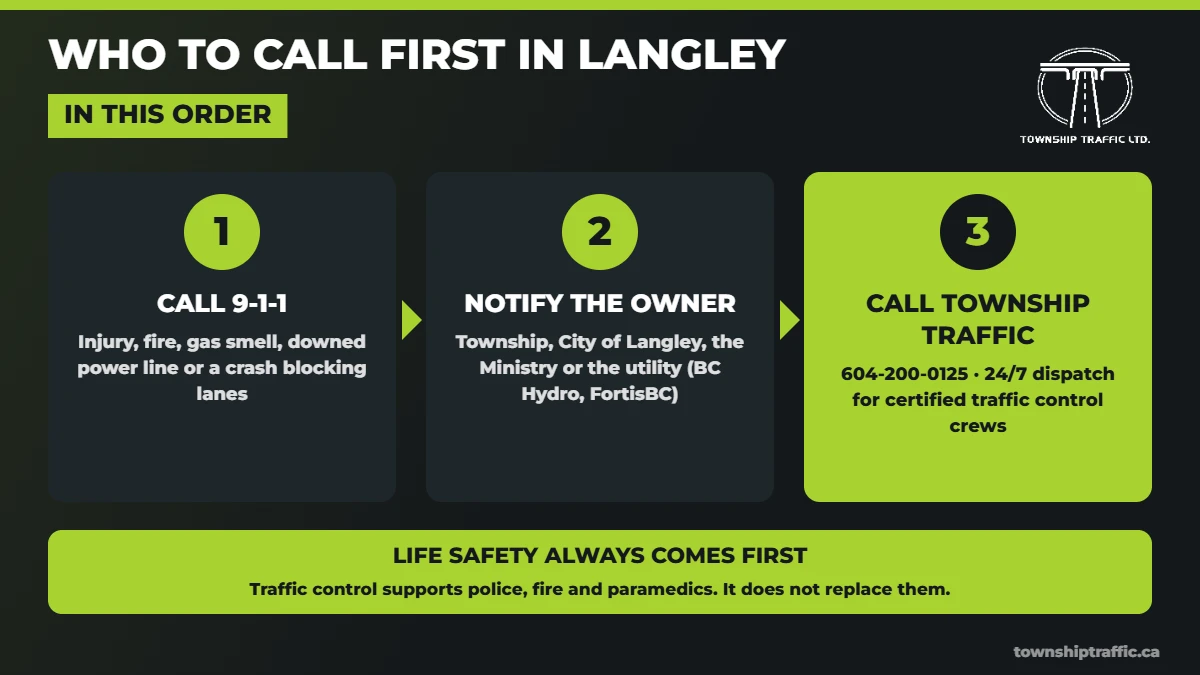
Who Should You Call First in a Langley Road Emergency?
The right first call depends on what has happened. Use this table as a starting point.
| Situation | Call first | Then call |
|---|---|---|
| Injury, fire, or a crash blocking lanes | 9-1-1 | Traffic control, once responders say the scene is safe to work |
| Downed power line | 9-1-1, then BC Hydro at 1-800-224-9376 | Traffic control to keep drivers away from the hazard |
| Gas leak or gas smell | Leave the area, call 9-1-1, then FortisBC at 1-800-663-9911 | Traffic control at the perimeter the utility sets |
| Water main break, sinkhole or failed pavement on a local road | The road owner: Township of Langley or City of Langley | Traffic control for the repair crew |
| Hazard on a provincial highway such as Highway 1 or Highway 10 | 9-1-1 if there is immediate danger, then the BC Ministry of Transportation and Transit | Traffic control that follows ministry requirements |
| Your own site, utility or equipment problem affecting the road | Township Traffic dispatch: 604-200-0125 | The road owner, to notify them of the closure |
If there is any threat to life, 9-1-1 always comes first. A traffic control company supports the response; it does not replace police, fire or paramedics.
Which Municipality Owns the Road: Township or City of Langley?
Langley is two separate municipalities. The City of Langley is a small urban area incorporated in 1955 and surrounded by the much larger Township of Langley. Each has its own engineering and operations staff, and which one you call depends on who owns the road. Provincial highways follow a third set of rules.
If you are unsure whose road it is, tell dispatch the nearest cross streets and we can help you work it out. Our guide to the Township vs. City of Langley permit rules explains the difference in detail.
Common Emergencies That Need Traffic Control in Langley
- Collisions that leave debris or block lanes after responders clear the injured.
- Water main and sewer breaks that undermine pavement or flood a lane.
- Downed power lines and utility strikes where a perimeter must be held.
- Fallen trees and storm debris during the wet season, which starts around November.
- Sinkholes and pavement failures that appear overnight.
- Flooding on low-lying roads and farmland routes in the Fraser Valley.
- Equipment failures at active work sites that suddenly put workers close to moving traffic.
Winter makes all of these harder. Our post on winter traffic management in BC covers how weather changes the setup.
How Fast Do Emergency Traffic Control Crews Respond in Langley?
Response time depends on the incident, the time of day and where the closest available crew is. We do not promise a fixed arrival time for every call, because a promise that ignores rush hour and road conditions is one we cannot always keep. What we can tell you is how the process works and what affects speed.
What you can count on from Township Traffic:
- A person answers. Dispatch at 604-200-0125 is staffed 24/7. You are not sent to an answering service or told to wait for a morning callback.
- Same-day response is available. Crews dispatch from our yard at 4481 232 Street in Langley Township.
- Local crews. Our team members live in Langley Township, Surrey and Abbotsford, so they know the corridors that back up at certain times of day.
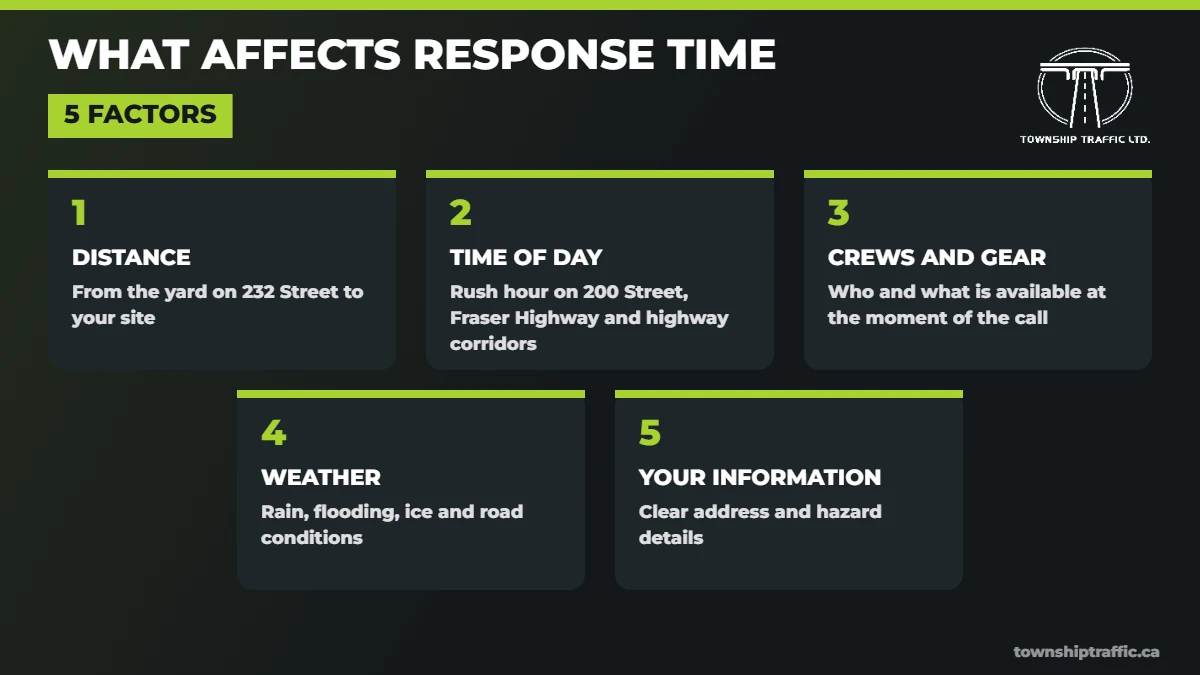
Factors that change how fast a crew can reach you:
- Distance from the yard and the route to your location.
- Time of day. Rush-hour traffic on 200 Street, Fraser Highway and the highway corridors slows every vehicle.
- Crew and equipment availability at the moment of the call.
- Weather and road conditions in storms, flooding or ice.
- The quality of the information you give dispatch. A clear address and description help the right crew and equipment leave the yard the first time.
What Should You Tell Dispatch When You Call?
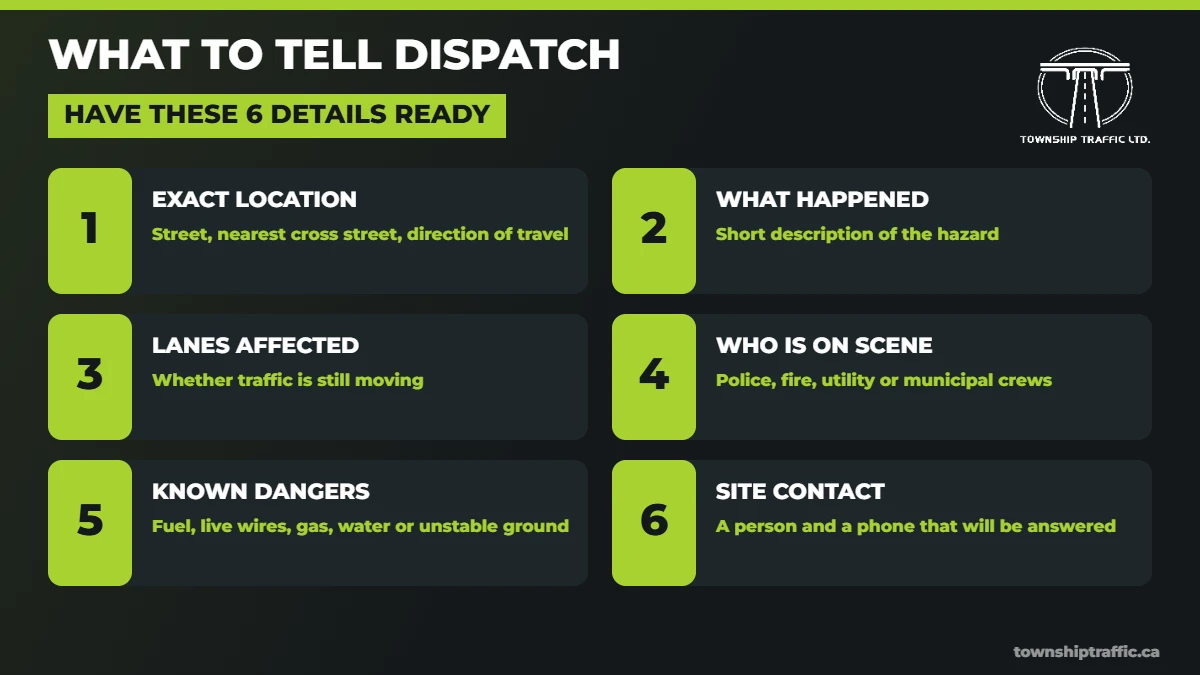
Have these details ready:
- The exact location: street, nearest cross street, direction of travel and any landmarks.
- What happened: a short description of the hazard and whether it is still changing.
- Which lanes are affected, and whether traffic is still moving.
- Who is already on scene: police, fire, utility crews or municipal staff.
- Known dangers: fuel spills, live wires, gas, standing water or unstable ground.
- A contact person on site and a phone number that will be answered.
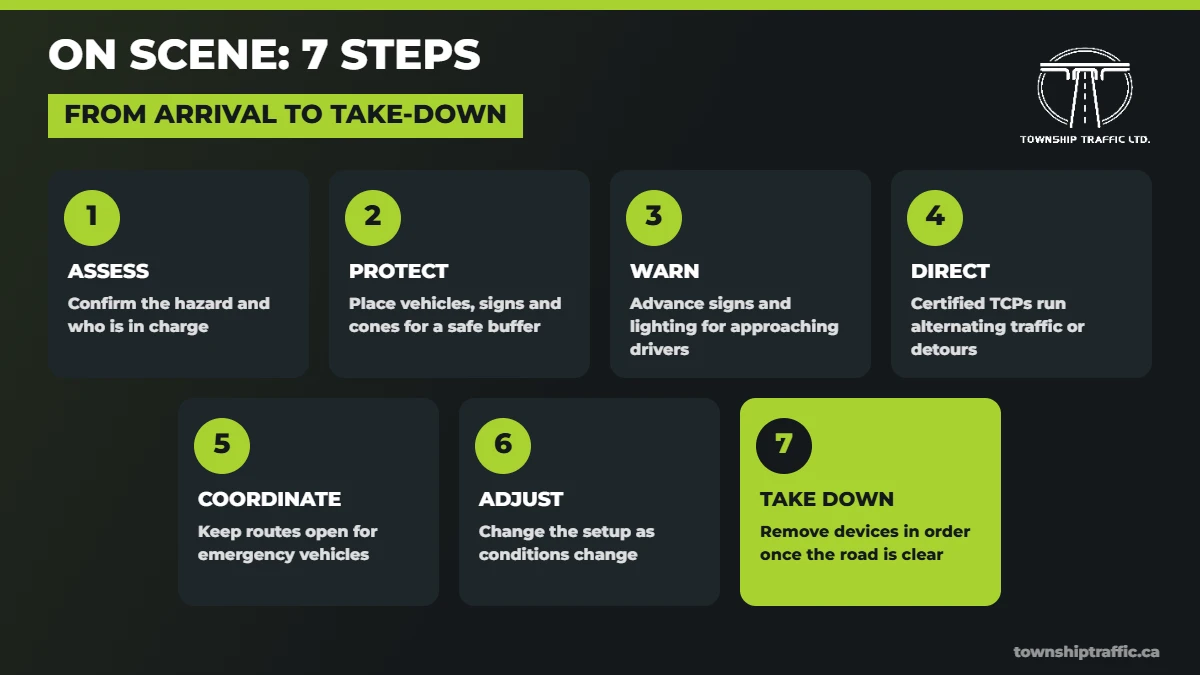
What Happens When the Crew Arrives?
- Check in and assess. The crew confirms the hazard, the road layout and who is in charge of the scene.
- Protect the work area. They place vehicles, signs and cones to give workers and responders a safe buffer.
- Warn approaching drivers. Advance signs and lighting give drivers time to slow down, especially at night.
- Direct traffic. Certified TCPs run alternating traffic, set up detours or hold traffic as the situation requires.
- Coordinate with other responders. Crews keep access routes open for emergency vehicles and follow instructions from police, fire and utility staff.
- Adjust as conditions change. If a lane reopens or the hazard spreads, the setup changes with it.
- Take down safely. Devices are removed in order once the road is clear.
Who Is Allowed to Direct Traffic on a BC Road?
In British Columbia, a person who directs traffic at a work site is a traffic control person, commonly called a flagger. WorkSafeBC’s Occupational Health and Safety Regulation, Part 18, sets the rules for traffic control. It requires employers to use traffic control plans, designate a traffic control supervisor, and make sure each TCP has completed Board-approved training.
That means pulling a labourer off the crew to wave traffic through is not a safe or compliant shortcut. It exposes the worker and the public, and it can expose the employer to penalties. The BC Construction Safety Alliance (BCCSA) delivers the TCP training that employers rely on. Our traffic control persons hold current certification, and the cards are in the truck.
For a deeper look at why training matters, read our guide on why trained flaggers are essential to road safety.
How Much Does Emergency Traffic Control Cost in Langley?
Emergency traffic control is priced hourly, with minimum call-out times and after-hours premiums. The main cost factors are crew size, certification level (TCP or lane closure technician), equipment, shift length and how much notice we have. We do not publish a flat-rate sheet, because flat rates in this industry tend to hide surprises. We give you a real quote with the line items broken out.
If you expect to need emergency support again, ask about setting up an account in advance. Having your details on file saves time on the call.
How Can Contractors and Property Managers Prepare Before an Emergency?
- Save the dispatch number, 604-200-0125, in every site supervisor’s phone.
- Keep site addresses, cross streets and access points on a one-page sheet.
- Keep a current traffic management plan for active work on file.
- Know who owns the road at each of your sites: Township, City or province.
- Check that your traffic control provider’s crews carry current certification.
- Agree on who authorizes call-outs after hours.
A night-work crew has different demands from a day crew. Our post on day versus night traffic control covers lighting, visibility and fatigue. For how we handle emergencies in a neighbouring city, see emergency traffic control in Surrey.
Why Langley Contractors and Utilities Call Township Traffic
- Based in Langley, not visiting it. Our yard is at 4481 232 Street in Langley Township.
- 24/7 dispatch. Call 604-200-0125 at any hour.
- Certified crews. BCCSA-certified TCPs and lane closure technicians.
- WorkSafeBC-compliant setups, with personnel that match the plan.
- Fully insured and experienced with both the Township and the City of Langley.
Need a crew now? Contact Township Traffic or call 604-200-0125. If someone is in danger, call 9-1-1 first.
FAQs About Emergency Traffic Control in Langley
Who do I call for emergency traffic control in Langley, BC?
Call 9-1-1 first if there is any danger to life. For traffic control support, call Township Traffic dispatch at 604-200-0125, which is staffed 24/7.
How fast can an emergency traffic control crew get to a Langley site?
It depends on distance, time of day, crew availability and road conditions. Township Traffic dispatches from Langley Township, offers same-day response and answers calls around the clock. Dispatch can give you an expected arrival time for your location when you call.
Is emergency traffic control available at night and on holidays?
Yes. Dispatch is available 24/7, including nights, weekends and holidays.
Can I direct traffic myself in an emergency?
If there is immediate danger to the public, get people to safety and call 9-1-1. For work-zone traffic control, BC rules require trained traffic control persons. Leave directing traffic to certified professionals.
Who is responsible for a road hazard in Langley?
The road owner is: the Township of Langley, the City of Langley, or the BC Ministry of Transportation and Transit for provincial highways. Tell dispatch the exact location and we can help you identify the owner.
Does emergency traffic control need a permit?
True emergencies are handled differently from planned work, but road owners still expect to be notified, and a longer closure may need formal approval. Ask the road owner or your dispatcher.
Do you serve both the Township of Langley and the City of Langley?
Yes. We also work in Surrey, Abbotsford and across the Fraser Valley.
How much does emergency traffic control cost?
It is priced hourly, with minimum call-outs and after-hours premiums. We provide a line-item quote.
Sources and Further Reading
This article gives general information and is not legal or safety advice. In an emergency, call 9-1-1. Confirm current requirements and contact numbers with the road owner, utility or regulator.