
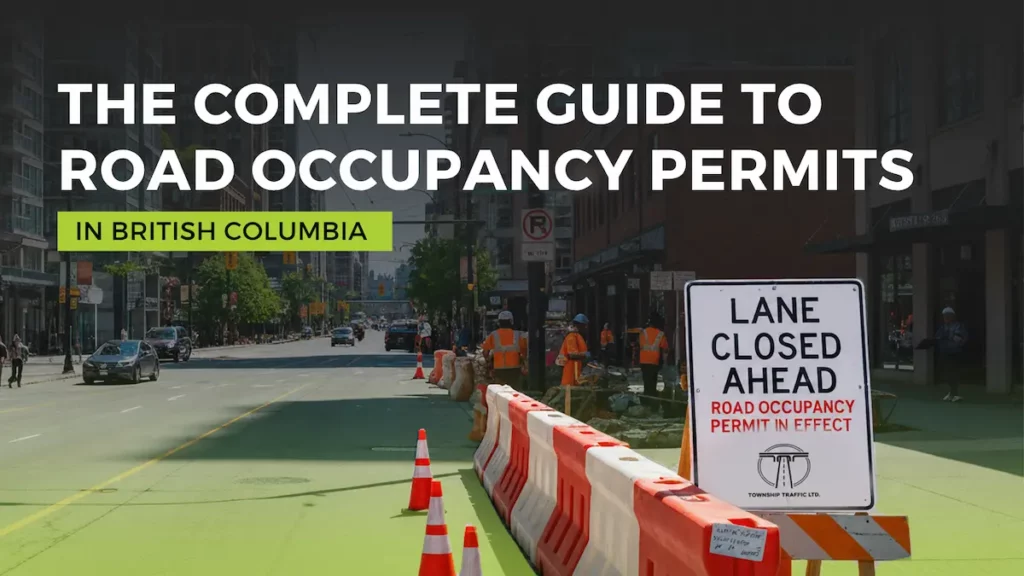
In British Columbia, you don’t touch a public road without the right permit. It doesn’t matter how small the job is, a sidewalk closure, a single-lane restriction, a utility dig, if it affects a public right-of-way, a Road Occupancy Permit (ROP) is required by law.
Also known as a Road Use Permit (RUP) in some BC municipalities, this authorization covers contractors, developers, utility providers, and event organizers alike. Work without one and you’re looking at stop-work orders, fines, and serious liability exposure.
This guide covers everything you need to know: what a Road Occupancy Permit is, when you need one, how BC municipalities manage the process, and what supporting documents, including a certified Traffic Management Plan, are required for approval.
What Is a Road Occupancy Permit in BC?
A Road Occupancy Permit is an official authorization issued by a municipality or the BC Ministry of Transportation and Infrastructure (MoTI) that allows temporary use or obstruction of public rights-of-way.
Public rights-of-way covered under a ROP include:
- Roads, lanes, and highways
- Sidewalks and crosswalks
- Boulevards and curbsides
- Utility corridors adjacent to roadways
The permit ensures that any activity affecting public access is properly coordinated, maintaining safe traffic flow, protecting pedestrians, and minimizing disruption to businesses and residents.
If your project or event interferes with normal public movement in any way, you almost certainly need a Road Occupancy Permit.
When Do You Need a Road Occupancy Permit in BC?
Construction and Utility Work:
- Lane closures for paving, sewer, or water line repairs
- Gas, electrical, or telecommunications upgrades
- Road excavations for infrastructure or civil projects
- Utility tie-ins requiring temporary road closures
Building and Development:
- Scaffolding or hoarding obstructing a sidewalk
- Staging cranes, dumpsters, or equipment on boulevards or road shoulders
- Material storage on public property during active builds
Community and Commercial Events:
- Parades, street festivals, and outdoor markets
- Film and commercial shoots requiring lane or road closures
- Temporary structures affecting public access
General Rule: Even minor obstructions, such as placing a bin on a boulevard or blocking a single sidewalk panel, typically require a permit. When in doubt, confirm with your municipality before work starts.
Who Issues Road Occupancy Permits in BC?
Road Occupancy Permits in BC aren’t issued by one central authority. Who you apply to depends entirely on the type of road your project affects.
Municipal Roads. For work on city streets, sidewalks, or local corridors, the permit is issued by the municipality where the work takes place. Here’s how the major Lower Mainland and Fraser Valley cities handle it:
- Vancouver — Road Occupancy Permit, construction, film shoots, public events
- Surrey — Road Use Permit, lane closures, material staging, hoarding
- Langley (Township) — Road Occupancy Permit, subdivision, and utility work
- Abbotsford — Road Occupancy Permit, road closures, traffic diversions, sidewalk obstructions
- Burnaby — Road Use Permit, development and infrastructure projects
- Chilliwack — Road Occupancy Permit, municipal maintenance, and utility operations
Provincial Highways If your project touches a BC provincial highway, Highway 1, Highway 99, or any other MoTI-managed route the permit does not come from your local municipality. It comes directly from the BC Ministry of Transportation and Infrastructure (MoTI). A certified Traffic Management Plan is mandatory for every MoTI application, regardless of project size.
Getting this wrong means restarting your application from scratch. Always confirm the correct issuing authority before you begin.
Key Requirements for a Road Occupancy Permit in BC
While processes vary by municipality, most BC Road Occupancy Permit applications require the following:
- Traffic Management Plan (TMP) A TMP must be prepared by a certified traffic control professional. It outlines signage placement, detour routes, flagger positioning, and work zone layout. This is a mandatory requirement for most lane closures and road-affecting work across BC.
- Proof of Liability Insurance Most municipalities require a minimum of $5 million in general liability coverage, with the municipality named as an additional insured party. Higher-risk projects may require greater coverage.
- Work Schedule Clear start and end dates are required. Projects that extend beyond the permitted window must apply for an extension, continuing work on an expired permit carries the same penalties as working without one.
- Application Fee Fees vary significantly by municipality and project scope. A minor sidewalk closure in a smaller city may cost a few hundred dollars. A multi-lane closure in downtown Vancouver can run into the thousands.
- WorkSafeBC Part 18 Compliance All road-affecting work must comply with WorkSafeBC Part 18, Traffic Control. This covers certified flagger requirements, personal protective equipment, signage standards, and overall work zone safety obligations.
Meeting all requirements upfront significantly reduces review time and avoids back-and-forth with municipal staff.
How to Apply for a Road Occupancy Permit in BC
Step 1 — Identify the Issuing Authority. Determine whether the affected road is municipal or provincial. Contact the relevant city engineering or transportation department, or MoTI for highway work.
Step 2 — Complete the Application Form. Most municipalities offer online applications through their city portal. Provide accurate details on location, project type, duration, and scope of road impact.
Step 3 — Prepare and Submit Supporting Documents: Attach a certified Traffic Management Plan, proof of liability insurance, and any additional drawings or site plans required by the municipality.
Step 4 — Pay the Permit Fee. Submit payment with the application. Some municipalities process payment only after approval.
Step 5 — Await Municipal Review. Simple projects may be approved within three to five business days. Complex infrastructure projects, major lane closures, or large events can take several weeks. Build permit lead time into your project schedule.
Step 6 — Follow All Permit Conditions. Conditions may include restricted work hours, noise limits, mandatory inspections, or additional safety requirements. Non-compliance can result in fines, permit revocation, or legal liability.
Why Road Occupancy Permits Matter for Contractors and Project Managers
For construction companies, utility contractors, civil firms, and municipal contractors operating in BC, a Road Occupancy Permit is more than a regulatory formality; it is a core project management requirement.
Operating without a valid permit exposes your project to:
- Immediate stop-work orders from the municipality or WorkSafeBC
- Fines and financial penalties against the prime contractor
- Increased liability if an incident occurs in an unpermitted work zone
- Project delays that cascade into schedule and budget overruns
- Reputational damage with municipal clients and future tender evaluations
A properly permitted project delivers:
- Full regulatory compliance with BC road safety standards
- Reduced liability for your company, your crew, and the public
- Clear coordination with municipal schedules and other active projects
- Demonstrated professionalism that supports long-term client relationships
For project managers working under tight timelines, getting the permit right the first time is far less costly than managing the consequences of a rejection or violation.
How Township Traffic Supports Your Permit Application
A certified Traffic Management Plan is a mandatory component of almost every Road Occupancy Permit application in BC, and a qualified professional must prepare it.
Township Traffic provides end-to-end traffic control support for permit applications across the Fraser Valley and Lower Mainland, including:
- Certified TMP preparation — compliant with MoTI and municipal standards
- Certified TCP crews — WorkSafeBC Part 18 trained flaggers for all project types
- Lane closure and detour management — safe, efficient traffic flow around your worksite
- Signage, barriers, and equipment — proper placement per approved TMP
- 24/7 project support — available for planned projects and emergency response
Township Traffic serves construction companies, utility contractors, civil firms, and municipal contractors across Abbotsford, Surrey, Langley, Chilliwack, Vancouver, and surrounding communities in BC.
Frequently Asked Questions
What is a Road Occupancy Permit in BC?
A Road Occupancy Permit is a legal authorization issued by a municipality or the BC Ministry of Transportation and Infrastructure (MoTI) that allows the temporary use, obstruction, or closure of a public right-of-way, including roads, sidewalks, and boulevards, for construction, utility work, maintenance, or special events.
Do I need a permit to close a lane in BC?
Yes. Any lane closure on a municipal road or provincial highway in British Columbia requires a Road Occupancy Permit or Road Use Permit from the appropriate authority. Most projects also require a certified Traffic Management Plan (TMP) to ensure the safety of workers, motorists, cyclists, and pedestrians.
Who issues Road Occupancy Permits on BC highways?
Road Occupancy Permits for provincial highways are issued by the BC Ministry of Transportation and Infrastructure (MoTI). If your work affects Highway 1, Highway 99, or any other provincial route, you must obtain approval directly from MoTI rather than the local municipality.
How long does it take to get a Road Occupancy Permit in BC?
Approval times vary depending on the project scope and location. Simple applications may be processed within 3 to 5 business days, while larger construction projects or work in high-traffic areas can take several weeks. To avoid delays, submit your permit application well before your planned project start date.
