
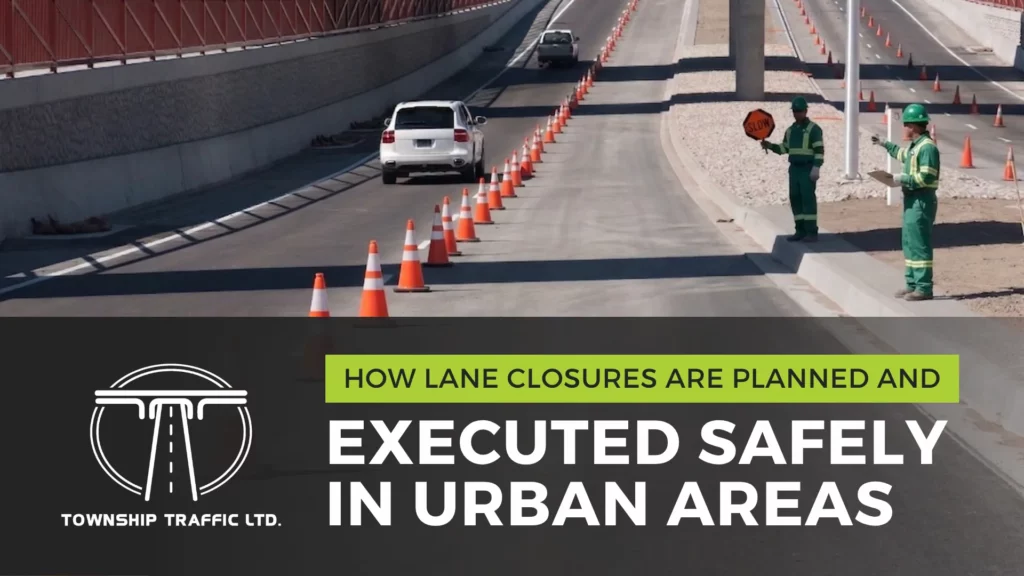
Every roadwork project in a busy city begins with a question that carries real consequences: how do you close a lane without causing chaos, endangering workers, or snarling traffic for miles? The answer lies in a methodical, standards-driven process, part engineering, part logistics, part human coordination that most drivers never see happening behind the orange cones.
This guide breaks down the entire lifecycle of an urban lane closure, from permit applications to the moment the last cone is picked up, and explains why professional traffic control services like Township Traffic are the quiet backbone of safe, efficient urban construction.
What Is a Lane Closure and Why Does It Matter?
A lane closure is a planned, temporary, or semi-permanent restriction of vehicle travel lanes on a public road. They occur during utility work, road resurfacing, bridge maintenance, building construction, and emergency repairs. Unlike rural highway closures, urban lane closures happen in environments dense with pedestrians, cyclists, transit routes, emergency vehicle paths, and intersecting side streets, each of which must be accounted for.
Done poorly, a lane closure creates bottlenecks that ripple through an entire neighborhood, exposes workers to vehicle strikes, misdirects emergency responders, and generates liability for project owners. Done well, drivers barely notice.
The Planning Phase: Permits, Assessments & Traffic Studies
No responsible lane closure begins without a formal planning phase. This is where traffic control companies earn their value long before a single cone touches the pavement.
Traffic Impact Assessment (TIA)
A TIA evaluates how closing one or more lanes will affect the surrounding road network. Analysts look at peak hour volumes, intersection capacity, nearby school zones, hospital access corridors, and freight routes. The goal is to anticipate where backups will form and pre-design detour or merge strategies to manage them.
Permit Applications
Most municipalities require a Right-of-Way (ROW) permit before any work can begin. These submissions typically include traffic control plans (TCPs) drawn to scale, site-specific risk assessments, haul route maps, noise and dust mitigation plans, and emergency access provisions. Many cities now require digital submissions with GIS-referenced drawings.
Stakeholder Coordination
A lane closure on a major arterial touches more stakeholders than most people realize: transit agencies need to re-route buses, school districts may need adjusted drop-off plans, businesses must be notified about access changes, and emergency services (police, fire, EMS) need to be briefed on alternate response routes.
Taper Zones, Buffer Spaces & Signage Placement
The geometry of a lane closure isn’t arbitrary; it follows MUTCD (Manual on Uniform Traffic Control Devices) standards in the US, or equivalent national guidelines elsewhere. Getting it right is what separates a safe zone from a crash zone.
1. Warning area
Signs placed 500–1,000 ft (or more) upstream alerting drivers to lane closure ahead.
2. Transition taper
Cones or barriers guide vehicles from the closed lane into the adjacent open lane over a calculated distance.
3. Buffer space
An empty zone between the taper end and the work area that absorbs an errant vehicle before it hits workers.
4. Activity area
The actual work zone where crews operate is clearly delineated and protected from traffic.
5. Termination taper
A short downstream taper allows vehicles to return to normal lane positions safely.
6. Downstream area
The zone past the work site where normal driving resumes signage confirms the closure has ended.
Taper length is calculated using a formula based on lane width and posted speed. At 40 mph on a 12-foot lane, a merge taper should be at least 320 feet. Cutting corners on taper length is one of the most common and most dangerous mistakes made by underqualified contractors.
On-Site Execution: Flaggers, Cones & Real-Time Control
Once the plan is approved and the geometry is set, execution is where certified traffic control professionals shine. This phase requires constant situational awareness and rapid decision-making.
Certified Flaggers
In most jurisdictions, flaggers must be certified; they’re not simply someone with a stop/slow paddle. Certified flaggers understand traffic flow psychology, hand signals, radio communication protocols, and emergency response procedures. They wear ANSI/ISEA Class 3 high-visibility gear and are positioned at calculated sight-distance intervals from the work zone.
Device Setup and Sequencing
Channelizing devices, cones, drums, vertical panels, and portable concrete barriers are placed in a specific sequence, always working from the upstream end first. Removal follows the reverse order. This prevents workers from ever walking into live traffic unnecessarily.
Temporary Traffic Signals
For single-lane alternating flow on narrow urban streets, temporary traffic signals are often more efficient and safer than flaggers alone. Modern temporary signal systems can be coordinated wirelessly and adjusted in real time to respond to queue buildup.
Local Traffic Control Experts
Township Traffic is a local traffic control service company specializing in urban lane closures, flagging operations, traffic control planning, and permit coordination. Their certified teams handle projects of all sizes from single-block utility cuts to multi-block arterial road work with the precision, documentation, and professionalism that municipalities and contractors demand.
Common Mistakes and How to Avoid Them
Despite clear standards, lane closures are frequently executed incorrectly, particularly when contractors attempt to self-manage traffic control without specialized expertise. The most common errors include:
Inadequate advance warning distance: Signs placed too close to the taper give drivers insufficient time to react, especially at higher speeds or in wet conditions.
Incorrect taper length. Short tapers force abrupt lane changes, increasing rear-end and sideswipe collision risk at the merge point.
Unlit or poorly visible devices: Nighttime closures require retroreflective devices and supplemental lighting. Many contractors underestimate the equipment needed for after-dark work.
Missing buffer zones: Placing workers directly behind the taper with no buffer is a serious safety violation. A minimum buffer of one car length per 10 mph of posted speed is a common standard.
Failing to update GPS platforms: If navigation apps don’t know a closure exists, their routing sends traffic directly into the work zone approach at full speed, exactly what you don’t want.
Frequently Asked Questions About Lane Closures
How far in advance does a lane closure need to be planned?
Most urban municipalities require permit applications at least 5–10 business days before work begins. Complex closures on major arterials or near transit hubs may require 3–6 weeks of advance notice to allow for stakeholder coordination and public notice requirements.
Do I need a permit to close a lane for a few hours?
Yes, in virtually every urban jurisdiction. Even short-duration closures (less than 4 hours) require a right-of-way or encroachment permit. Emergency utility repairs may be exempted, but must usually be followed up with after-the-fact documentation.
What is a traffic control plan (TCP), and who creates one?
A TCP is a site-specific document usually drawn to scale that shows the placement of all signs, cones, barriers, flaggers, and detour routes for a work zone. TCPs are created by certified traffic control planners or engineering firms and submitted as part of the permit application. Companies like Township Traffic provide full TCP development as part of their service offering.
How long can a lane closure last?
Permit terms vary widely. Some cities allow continuous closures for weeks on major construction projects; others restrict lane closures to off-peak hours only (e.g., 9 PM–5 AM) to minimize traffic impact. The permitted duration is determined during the application process based on traffic volume data and project scope.
What’s the difference between a lane closure and a road closure?
A lane closure restricts one or more lanes while allowing through traffic to continue in adjacent lanes. A road closure (or full closure) blocks all travel lanes, requiring traffic to detour onto alternate routes. Full closures require significantly more planning, public notification, and often higher-level municipal approval.
What is Township Traffic, and what services do they provide?
Township Traffic is a local traffic control service company that provides lane closure planning, certified flagger services, traffic control plan development, permit coordination, and on-site traffic management for construction and utility projects in urban areas. They work with contractors, municipalities, and utility companies to ensure every lane closure is executed safely and in full regulatory compliance.
